Tuesday

"The Brave Little Toaster"

image via
Fear: An Imaginary Portrait of the Creative Team Behind The Brave Little Toaster

Visionary #1: You know what I've always wanted to do?  Make a film that really forces an encounter with the shadow archetype in a Jungian sense--something that so terrifying that it could provoke an increased fear response, perhaps even triggering a phobia, outside the normative ontogenetic parade.

Visionary #2: Oh, sure.  So, a Disney children's film, then?

V1: Of course.  But kids are so jaded these days--what's left that would scare them?

V2: How about a horribly deformed toy? 

V1: That's a good start.  For maximum horror impact, I'm thinking a creepy doll-- no, just its head!  And it has a missing eye!  And the body of a mechanical spider!  And it's alive!

V2: We could call it "Spider Baby!"

V1: Ah, no, that's no good; toys come to life has been done before.  We need something even more uncanny.  How about household appliances come to life?

V2: The marketing team won't like that.  What kind of character would they use to promote the movie, a desk lamp?

V1: It's so crazy, it just might work!  Plus, can you imagine the retail opportunities?  Kids begging their parents to buy them vacuum cleaners, refusing to go to sleep unless they can cuddle their clock radios, playing in the bath with their toasters...

V2: Well, maybe not that last one.  So what else are kids afraid of?  Lightning?

V1: Done!  Let's fry a protagonist with it.

V2: How about fear of death?

V1: Yes!  I'll add in some near-misses with drowning, quicksand, vivisection, and then for the grand finale... a car crusher!

V2: Gosh, that's a little drastic, isn't it?

V1: Not at all!  Here, I'll have a car go into the crusher on purpose, just to show it's no biggie.  Automotive suicide!  Now there's a phobia I bet they haven't included in the DSM yet.  It's still lacking something though, something universally terrifying, something so sinister their sheets won't be dry for weeks...

V2: Um... an evil clown?

V1: Perfect!

Lesson learned:
"Run."

The Brave Little Toaster.  Dir. Jerry Rees.  Perf. Deanna Oliver, Jon Lovitz, Tim Stack.  Hyperion, 1987.
 
Buy The Brave Little Toaster DVD

Monday

Tinny tune adventures

image via
One of the things I've discovered as a parent is that kids' stuff tends to play music--and I use that term loosely.  Whether it's a mutant stuffed animal or an infant swing, you can bet that if you turn a knob, squeeze it, jiggle its foot, or whatever, it's going to have the capacity to play a tinny MIDI tune of "If You're Happy and You Know It" or "Twinkle, Twinkle, Little Star" ad infinitum, and you're soon going to start hearing these ditties on a loop in your sleep, maybe even accompanied by dreams that you're driving an ice cream truck... to Hell. 

I feel like the makers of these toys are perhaps conducting some kind of covert psychological testing on new parents--something like the Stanford Prison Experiment, where the prisoner-parents cease to remember who they are or why they're there, knowing only that they are hearing "It's a Small World After All" for the five hundredth time and maybe even starting to think they like it.  It seems the folks over at Sterling Cooper Fisher Price have become masters of the earworm, selecting only songs more insidiously catchy than "Chili's Baby Back Ribs" and more inane than "MacArthur Park."  And while I've already explored the beautiful dark twisted fantasy that is "Rock-a-Bye Baby," I'd be remiss not to mention a few other favorite toddler tunes that have some pretty messed-up messages.

"Alouette"--All about plucking the feathers off a poor lark (Big Bird?), body part by body part.  Second only to "Baby Bumblebee" as the theme song of animal torture aficionados and future serial killers.

"Oh My Darling Clementine"--A miner's girlfriend tragically drowns so he consoles himself by getting busy with her little sister instead.  With its incestuous overtones, a favorite folksong in West Virginia.

"Hush, Little Baby"--Don't say a word.  Because I'm going to buy you a series of inappropriate and ill-thought-out gifts, and when they all inevitably break, or die, I'll throw more money at the problem in hopes that you'll love me.  The ballad of the absentee father?

Lesson learned:
Cheer up!  At least there are "cigarette trees" to look forward to in "The Big Rock Candy Mountain," so it's not all bad.  (Well, until you're "buggered sore," that is...)

Buy 100 Singalong Songs for Kids CD

Friday

"Little Boy Blue"

image via
Some childhood trauma seems to be nearly universal if you came of age at a certain time--what child of the Eighties didn't have nightmares about wheelies?--but other sources of fear are unique to the individual.  I'm not sure anyone else on the planet shared my horror at the Study in the board game "Clue," for example.  But I have been surprised at how many people remember--and not with fondness--the Uncle Arthur stories.

I haven't ever encountered anyone else who had this particular experience, but for some reason, the "Little Boy Blue" poem I knew growing up didn't have anything to do with blowing horns or cows in the corn.  I remember asking other children at school if they knew "the real version" and being stared at as if I had lobsters crawling out of my ears.  The version I knew--by Eugene Field--was a bit more bleak than the well-known nursery rhyme.  It begins:

The little toy dog is covered with dust,
   But sturdy and stanch he stands;
And the little toy soldier is red with rust,
   And his musket moulds in his hands.
Time was when the little toy dog was new,
   And the soldier was passing fair;
And that was the time when our Little Boy Blue
   Kissed them and put them there.

The poem confirmed my belief in the emotional lives of toys, and upped the stakes a bit, because not only could they die, but you could die as well!  The phrasing too of the child's death-- "And, as he was dreaming, an angel song / Awakened our Little Boy Blue," was eerily similar to the conclusion of "Jesus Understood," and suggested the possibility that not only could Jesus kidnap and murder you, but there were angelic henchpersons who could do the deed as well.  I imagined them toting around harp-cases with guns in them, like heavenly old-time gangsters.


Lesson learned:
Always make provisions for your stuffed animals in your will.

Field, Eugene.  "Little Boy Blue."  1888.

Buy 101 Famous Poems

Saturday

The Island of Misfit Toys

Now that I'm a parent, I often wonder what future blog fodder I might be exposing my child to.  Of course, I'm not going to be reading any Uncle Arthur stories at bedtime, and I won't be popping Return to Oz in the DVD player expecting Bert Lahr's jowls to be the scariest aspect of it, but it seems as though a certain amount of childhood trauma is inevitable.  This truth has recently been driven home for me since I've started having nightmares about alien giraffes.  Let me explain why.  First, a quick review--

This is what a giraffe looks like:
Note the horns.  (image via)

However, this is what a giraffe looks like on children's goods:
G: Giraffes have spots.
A: And, apparently, antennae.

 Here are a few other examples of the Alien Giraffe phenomenon:


And the weirdest one of all... the giraffe who was in a horrible spill at a chemical factory, and as the ooze pooled around his mangled feet, was transformed into this monstrosity:

Once you start noticing it, you'll begin to see hideous, smiling Island of Dr. Moreau-type creatures everywhere you look.  
To wit:
Front legs attached backwards, or the knuckle-walking monkey (not ape, note the tail) that evolution forgot?


A zebra with a dog's nose, or the white tiger that ate Roy--with a mohawk?
Then there are children's clothes.  Sometimes they have very helpful instructions embroidered on them:
(A useful reminder about reducing the risk of SIDS)
And sometimes, they offer really terrible advice:
What's next?  A romper with rattles that says "Shake me," a onesie with soccer balls that says "Kick me," or a footie pajama set with frolicking lambs that says "Marinate me, roast me until tender, then serve me with mint chutney"?
Lesson learned:
At least if you catch the mutant giraffe toy moving, you can kill it.

Monday

"Little House on the Prairie"

image via
My television-viewing options were quite limited as a kid.  "The Simpsons" was unknown to me until college, and even "The Wonder Years" was off-limits due to its treatment of burgeoning young adult sexuality.  I was, however, allowed to watch ABC's catchphrase-laden "TGIF" lineup (and "Did I do that?"  Why of course, "don't be ridiculous!"... OK, now I'll "cut! it! out!"...), which I'm sure rendered me a joy to be around. 

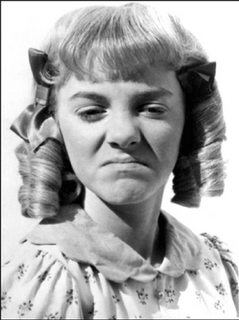
I was also allowed to watch "Little House on the Prairie," which played in syndication on a seemingly endless loop on TBS.  It looked like wholesome family fare, what with the smiling Laura in her gingham frock playing airplane in the meadow (anachronism?  hmm...) and leaping joyfully in the air at the end of every episode.  Sure, there was conflict--often driven by Nellie "Bad Seed" Oleson and her busybody mother--but there wasn't any swearing, and even if there ever was, Pa would probably fiddle right over it and make it all better again.

But there was also a darker side to the "Little House."  And it made me afraid of two things: nosebleeds, and cornmeal.

Nosebleeds?  Well, that's what killed off Albert.  It meant he had leukemia (!!!) and was going to die.  Imagine my terror after every pinkish-looking sneeze thereafter.

As for the cornmeal, there was an episode called "Plague" where rats have infested the town's cornmeal supply, which gives everyone typhus.  I have been suspicious of cornbread ever since.  Yes, it might make a delicious accompaniment to chili, but is it really worth dying for?

There were other traumatizing episodes too--I mean, life on the prairie was hard, and as The Oregon Trail will teach you, death is pretty much inevitable--not to mention "Sylvia," which involved a masked child rapist who kills Albert's first love (not horrific enough for one episode, they extended it out for two!), but that's a tale for another time.  Play us off, Pa!

Lesson learned:
Maybe it wasn't such a bad idea that they blew up the entire town.


"Little House on the Prairie."  Worldvision/NBC 1974-83.  Perf. Michael Landon, Melissa Gilbert, Karen Grassle.
Buy Little House on the Prairie: The Complete Nine-Season DVD Set

Saturday

Goodnight gosling

image via
My apologies for the lack of updates!  I--well--I hatched a gosling, so to speak.  So I have been reading--and rereading, and rerereading--a lot of board books lately, and have discovered that even with a monosyllabic vocabulary and an average of five words per page, there's often the suggestion of something sinister.

For instance, in Goodnight Moon there is that old lady who demands, in a whisper, that we must "hush."  Given the sparse furnishings of the rodent-infested room, I find this suggestive of what is perhaps a hostage situation.  "Goodnight nobody" and "goodnight noises everywhere"?  Maybe in the little house with the red balloon, nobody can hear you scream. 

Lesson learned
You don't want to know what's in the mush.

Brown, Margaret Wise.  Goodnight Moon.  HarperCollins, 1947.
Buy Goodnight Moon

Wednesday

"The Witches"

image via
Writing about The BFG the other day, I was shocked to realize that I hadn't yet taken a look at Roald Dahl's work.  Surely no other author tapped so well into a child's complex psyche-- he gave us the terrifying thrills we craved, the naughty humor we guiltily loved, and he never talked down to us.

After I'd devoured all of Dahl's books in the "Juvenile" section of the library, I remember eagerly moving on to his other titles-- the ones way over in the "Adult" section.  They didn't have Quentin Blake's illustrations, but they did have a man who had his skin flayed for his tattoo, a woman bludgeoning her husband to death with a leg of lamb, and a compulsive gambler who chops off people's fingers.  Such wonderful, twisted stuff!  I imagined that all those "adult bookstores" I saw signs for downtown must have shelves full of similar stories.

For some reason, just the label "Adult" had prepared me to expect the morbid twists and turns in those books, but the same Hitchcokian plot devices absolutely shocked me in Dahl's fare intended for children.  The one that most stuck with me was from the end of The Witches.  The hero, a little boy, gets turned into a mouse and doesn't ever get turned back!  Then Dahl goes for another turn of the screw--the boy asks his grandmother how long a mouse can expect to live.

‘A mouse-person will almost certainly live for three times as long as an ordinary mouse,’ my grandmother said.  ‘About nine years.’
‘Good!’ I cried. ‘That's great! It's the best news I've ever had!’
‘Why do you say that?’ she asked, surprised.
‘Because I would never want to live longer than you,’ I said. ‘I couldn't stand being looked after by anybody else.’
There was a short silence. She had a way of fondling me behind the ears with the tip of one finger. It felt lovely.
‘How old are you, Grandmamma?’ I asked.
‘I'm eighty-six,’ she said.
‘Will you live another eight or nine years?’
‘I might,’ she said. ‘With a bit of luck.’
‘You've got to,’ I said. ‘Because by then I'll be a very old mouse and you'll be a very old grandmother and soon after that we'll both die together.’

Yes, this is "the best news [he's] ever had!"--the fact that he will only live another eight or nine years, that he will remain a mouse, and that he will die in tandem with his aged grandmother.  Way to dream big, kid.

Now, I realize that if this plot were to be found on the shelves of an "adult bookstore," it would only appeal to a very, very, very specialized kind of audience-- folks more twisted than even Dahl's tales.


Lesson learned:
Did you know that the heart of a mouse beats at the rate of five hundred times a minute?

Dahl, Roald.  The Witches.  London: Jonathan Cape, 1983.
Buy The Witches